
Holt
The Holt family made their home in rural Pulaski County, where Randall C. and Elsie Ann Holt raised their four children and built a life grounded in hard work and strong values. In 1947, Randall signed his daughter Mary D. Holt onto the Corbin et al. v. County School Board of Pulaski County (1947) lawsuit, despite the fact that he had only completed third grade and Elsie fifth — a testament to how deeply they believed in education for their children. Randall worked in farming and later as a butcher, laboring for decades to provide opportunities he and Elsie never had. Their descendants remember them as steady, principled parents whose belief in education, faith, and family shaped generations to come.
Explore the quilt by clicking on the various elements
For best user experience, use full screen mode.
An interactive graphic of the quilt square. The linked information can also be found below.
The focus of the design on this quilt block is a tree made out of prominent gold fabric, detailed with the names of the family on each branch. On the tree’s lowest branches, mother and father, Elsie Ann Holt and Randall C. Holt, are honored with their names. Following them are the names of their four children, each having their own branch. The Holt family quilt square took the ideas of a crazy quilt by incorporating many different fabrics, colors, and ideas, while also creating a consistent theme and design, creating an intentionally thought-out design with many meanings and significances.
Learn More About the Holt Family
The Lawsuit
Included in the Holt quilt design is a section of the Original Lawsuit file that lists the case number as well as where it was filed. While designing the Holt quilt square, it was important to highlight the lawsuit in itself as a way to commemorate the courageous and difficult act of signing onto a civil rights court case in the 1940’s. The Holt family, along with 23 other families were brave enough to sign onto such a controversial document because of how important education was to the Holt family. One of the most commendable truths about this lawsuit is that this file, and the case as a whole, is that it represents an African American community in rural Southwest Virginia coming together to challenge the status quo of “separate but equal” schools and bring light to the lack of equality within the separated spaces for children’s education.
Recurring Themes:
Familial Connection: Represented by the Tree
Spreading throughout the entire Holt family quilt block is a golden tree which stretches its branches to every side and corner of the block. Symbolizing the interconnectedness and continuity of the family’s history from past ancestors to descendants of today, the tree highlights how older generations have influenced and helped the younger generations of the family. The Holt family was big, with many familial and local relationships and influence in Pulaski. As George Morrison describes, there was always an understanding in the family of “who you are, and whose you are,” creating a strong familial connection between the many different branches on the family tree. Throughout the many family reunions, gatherings, weddings, and funerals, the family was very present in each other’s lives, while also being present in the community. The two bottom branches of the tree are embroidered with the names of Randall C. Holt and Elise Ann Holt, parents of the four children listed in the thinner branches that spread across the top of the tree. The tree symbolizes the familial connection between the parents and their four children, with each core value held by Elsie and Randall Holt traveling up the tree trunk into each value and moral system of the children embroidered on the higher but younger branches. Values such as education, hard work, and political involvement were passed down from those who came before Randall and Elsie Holt. This still has a lasting legacy on the descendants of the Holt family, such as George and Kathleen Morrison.
Education: Represented by the Ruler
With the highest grade completed by Randall C. Holt being 3rd grade and the highest grade completed by Elsie Ann Holt being 5th grade, both parents placed a high value on obtaining an education for their children. Knowing the difficulties that come with not having the opportunity to receive a secondary education, Randall C. Holt made sure all four of his children were able to complete both primary and secondary school, and encouraged higher education for the female children, as Cecil went into the Navy after high school graduation. Randall C. Holt did not just stop at making sure his children were attending school. Still, signing his daughter Mary onto the Corbin et al. v. County School Board of Pulaski, VA. et al. suit, he was also fighting for a higher quality of education for his children that was not limited by discriminatory practices carried out by the Pulaski County School Board. The value placed on education in the household of the Holt family, which began with Randall and Elise Ann Holt, was carried on by their children and is evident in Irene Holt Morrison’s career as an educator and Gladys’s work as a teacher and a librarian. Irene Holt Morrison was able to pass down her love for education onto her children, Kathleen and George Morrison, by encouraging both of them to have an appreciation for reading, while also bringing the two of them to her summer college classes while finishing up her second college degree with a Bachelor’s in Education from Virginia Union University. By asking her children, “if education weren’t so important, why did they work so hard to keep it from us?” Irene embedded education into her two children’s lives as a means to lift them above barriers placed upon African Americans in the job market and general life. Both George and Kathleen were able to obtain graduate-level degrees because of the generations of importance placed on education and the opportunities given to them by their mother and grandparents, respectively.
Hard Work and Sacrifice: Represented by the Farming section at the bottom
Randall C. Holt was listed on the 1940s census as a farm owner and on his death certificate in 1960 as a butcher 1. Both of these careers require a lot of manual labor and hard work, chosen by Randall Holt to provide for his family and give his children opportunities he was not afforded. The purple fabric striped with vines covers the bottom of the quilt square on each side of the tree, representing the lines of crops typically seen on a farm. On top of these two areas representing the farm are all symbols that represent the different careers of Randall C. Holt, such as cabbage, a rake, and knives. Before tending to the farm created on the land of their house, Randall C. Holt worked several labor-intensive jobs, such as manning a furnace to provide for his family. While losing both of his legs to diabetes by the time of 1950, Randall did not let this stop him, and his nature to provide, as he continued to work after making leather slings and makeshift mobility aids for himself, as he then got a job working as a butcher on “slaughterhouse road” 2. By working hard, tough, physically strenuous jobs, Randall C. Holt could provide for his family, instilling the value of hard work in his children, and affording them more opportunities to pursue an education longer than he had. The passing of these values onto the four children is evident in Irene Holt Morrison’s career as a teacher, as she gave up her medical school scholarship to help raise her two younger sisters by working at the Rich Hill School in Allisonia. Cecil’s entrance into the Navy during the long, strenuous, and dangerous conflict of World War II is also a key example of how Randall C. Holt passed down his core value of hard work and dedication to his four children, ultimately leading all of his children to live successful and fruitful lives.
Artifacts by Family Member
Irene Holt Morrison (1926-2017):
Irene Holt Morrison was born in Pulaski County, Virginia, as the second of five children to Randall Clinton Holt and Elsie Ann Hall Holt. She graduated from Christiansburg Industrial Institute in 1945 and then attended Morristown College in Morristown, TN, where she initially planned to become a physician 3. In 1947, upon graduation from Morristown College, she returned to her home and family in Pulaski, VA, to care for her ill mother, where she was offered a teaching position at the Rich-Hill School in Allisonia. She taught first through ninth graders in the one-room schoolhouse in Allisonia for 16 years before joining the faculty at Calfee Training School 4. Morrison was a key advocate for equal education in Pulaski County and was active in the African American Teachers Association throughout her career. During her time at the Rich Hill School, she encouraged parents of her students to petition the Pulaski County School Board to provide a bus for the students which provided Black students with the opportunity to pursue an education beyond Rich Hill 5. Later, she advocated statewide for the inclusion of African Americans on local and state Educational Boards. During her teaching career, Irene pursued a Bachelor of Science in Education by completing summer classes at many universities and eventually graduating in 1977. Her two children, George and Kathleen Morrison, remember their mother to be a hard-working, highly educated, and determined woman who had a long-lasting impact on their family, the students she taught, and the community she served6. She is remembered fondly as “Miss Hope” to many students she taught because of her ability to encourage her students and bring hope to the classroom.
Symbolic Representation:
Photo of Irene Holt Morrison:
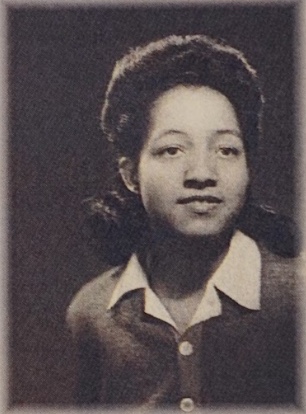
On the left side of the quilt square under her name is a portrait of the late Irene Holt Morrison. The youthful picture of Irene Holt Morrison was added to the quilt block to honor her contribution to her family and community by returning to Pulaski after college to be a teacher. By the 1950s, 23-year-old Irene Holt was listed as living in her father’s home, who was unable to work at the time, as the only steady source of income in the house from her job at the Rich Hill School7. Working to support her father and her two younger sisters, who still lived in the house, Irene Holt Morrison selflessly sacrificed a lot for the betterment of her family. Because of the hope she brought to her students and community, she was known affectionately as Mrs. Hope to many inspired by her, including her students8.
Dedicating over 40 years of service to the community through teaching and education, Irene Holt Morrison has been a pillar for the Pulaski County community in every field, club, church, and organization she was a part of. Her impactful legacy lives on after her passing.
Photo: Irene Holt Morrison taken from Funeral Program, Sept. 3rd, 2017
Apple:
An apple is below her name and next to her portrait to represent Irene Holt Morrison’s commitment to her and her students’ education. Apples are commonly associated with teachers and education because of their symbolic representation of knowledge. Therefore, it was only fitting to include an apple on the quilt square next to the portrait of Irene Holt Morrison, as she used her vast array of knowledge to educate students for decades. She not only made her students feel a love for education and reading, but her two children, George and Kathleen Morrison, remember their mother as someone who inspired both of them to appreciate reading, museums, and even plays or theatre productions. Often used as a gift of gratitude towards a teacher that a student is especially grateful for, the likelihood that Mrs. Hope has received an apple from a student at some point in her teaching career is very likely. Adding the apple to the quilt block for Irene Morrison’s presence in the classroom is one of the many apples she has received to honor her commitment to her students’ education.
Randall C. Holt:
Born in 1890, Randall C. Holt was the husband of Elsie Anna Holt and the father of his four children, Irene, Gladys, Mary, and Cecil. Initially working as a laborer for the Dora Furnace, Virginia Iron, Coal & Coke Company in Pulaski for most of his early life, after the closing of the furnace company in 1930, Randall was left to find another way to support his family 9. After the Dora Furnace company closed, Randall C. Holt likely converted his home off Dora highway, which he had lived in since 1920, into a farm to support his family10. According to his death certificate from August 31, 1960, by the time of his death, he was considered a butcher who worked for “Southern States.”11 These professions require manual labor, physical strength, hard work, and long hours. While only receiving a 3rd-grade education, Randall C. Holt worked multiple demanding and labor-intensive jobs to provide for his family. Randall C. Holt and his wife, Elsie, sacrificed so much for the betterment of their children’s lives and futures. They also pushed for their children to take schooling seriously because of the increased opportunities education gave to black citizens at the time. Randall C. Holt fought for his children’s education by signing his daughter, Mary Holt, into the 1947 lawsuit, Corbin et al. v. County School Board of Pulaski County, VA. et al. By doing this, he put himself and his family at risk of scrutiny or targeting by those in power and other racist people in the area. The sacrifices made by Randall C. Holt, including his many hard jobs and the legal action he took, made it possible for all of his children to finish high school and led some of them to be able to graduate from college.
Symbolic Representation:
Cabbage and Rake
- In the 1940 census, Randall C. Holt was listed as a self-employed farmer who owned his land12. The label of farming in Randall C. Holt’s career was a stark difference from the many other census records and other documentation that listed his occupation. With the closing of the company he worked for for around 20 years in 1930, it’s more than likely that farming was resorted to by Randall C. Holt to make money for the family13. Out of the need for a second income in the household as his wife’s career as a private homemaker was not enough to sustain their four children, Randall C. Holt made do with what he had by conducting farmwork on his land, which he already owned. Likely converting his home, which he owned for multiple decades, into a farm, Randall C. Holt was a dedicated provider for his family, doing back-breaking and intensive labor work. Specifically remembered by George Morrison, grandson of Randall Holt, was the presence of fruit trees, specifically cherry trees, on Randall’s property, from which he would sell the fruit to local families in the area14. To symbolize his work as a farmer, including line drawings of a cabbage and a rake onto the quilt design, is meant to honor the hard work Randall C. Holt did while times were uncertain for the family.
Knives
- No longer able to complete the physical demands that a farm requires by 1950, Randall was living in the same house but unable to work due to losing both legs to diabetes15. While working as an elementary school teacher, Irene Holt could use her income to help her father and two younger sisters, who lived in the house at the time. By 1960, Randall C. Holt was considered a butcher, working for “Southern States” in Pulaski16. Even though Randall lost both of his legs because of diabetes, he did not let that stop him from continuing to work for his children’s livelihoods. Creating leather slings and makeshift aids in mobility for himself, towards the end of his life, Randall Holt worked as a butcher on the infamous “slaughterhouse road” in Dublin17. Butchering was not only a labor-intensive job but also a job requiring a lot of knowledge and skill about animals and meat. The job of butchering offered a space for black men to hold the title of a skilled laborer, despite the discriminatory barriers placed on Black Americans affecting economic and educational opportunities18. Randall C. Holt provided for his family by being a skilled laborer in the art of butchering towards the end of his life, thus making it possible for his children to prioritize their education and earn higher education degrees.
Elise Ann Holt:
Elsie Ann Holt was born Elsie Ann Hall on August 26, 1892, to parents Lewis Hall & Lucy Bateman in Pulaski County, Virginia19. Elsie married Randall C. Holt sometime between 1910 and 1917 and would go on to have four children with Randall C. Holt. By 1920, the couple bought their home on Dora Highway in Pulaski, down the road from Randall’s job as a furnace worker at the time20. Throughout most of her married life, she did not have a formal job and would primarily act as a stay-at-home mom to care for the children. By 1940, she was working as a private homemaker for other households as an extra source of income to support the family after the likely layoff of Randall C. Holt after the closing of the Dora Furnace company21. Private homemaking was a common job among Black women before the passing of the 1964 Civil Rights Act because of the limited job opportunities, career options, and access to education or funding for education that was placed on the Black community in the era of Jim Crow. In 1940, 60% of all employed Black women in the United States were listed as domestic servants or private homemakers22. Contributing both in and out of the family home in terms of work, Elsie Ann Holt was a vital member of her family as the mother of four children who advocated for her children to obtain an education and live fruitful lives. In the summer of 1948, Elsie Ann Holt fell ill with a form of cancer, which encouraged Irene Holt to come back to Pulaski to take care of her mother until her passing in 1948, as well as her two younger sisters who were still in the house 23.
Gladys G. Holt Sokolow
Gladys Holt Sokolow was born in 1932 in Pulaski County as the youngest of 4 siblings to parents Randall C. Holt and Elsie Ann Holt. Growing up, Gladys attended both Calfee Training School and Christiansburg Industrial Institute 24. Gladys graduated from Christiansburg Industrial Institute in 1953, just 13 years before the school’s last graduating class finished their education in 1966 and the school being permanently closed, divided to sell, and mostly demolished, except for the Edgar A. Long Building, which still stands today25. After graduation, Gladys landed a teaching position in Pulaski and continued to live there for 29 years. By the time Gladys had been teaching for a few years in Pulaski, she realized she was “unhappy with the system” and ended up leaving in April of 1959 to live in New York City, spending 42 years there working in a city library26. In 2002, Gladys returned to Virginia, moving to Christiansburg to be closer to her family and siblings who still lived locally as she got older. Once she returned to Christiansburg, she quickly got involved with the Christiansburg Institute Alumni Association (CIAA) and the non-profit organization, Christiansburg Institute, Inc. (CI Inc.). She recalled that she “somehow got roped into” being the Treasurer of the CIAA Board of Directors and the Executive Director of the nonprofit CI, Inc. Board of Directors after humbly wanting only to be involved in CIAA as a board member27. As a CI Inc. Board of Directors member and Executive Director Emeritus, she focused on obtaining and restoring the Edgar A. Long building, the only school building still standing from the original CII campus, for the organization. Being one of the few community members a part of both organizations, she bridged the gap between CIAA and CI Inc., which created streams of communication and cooperation between the organizations.
Symbolic Representation:
Graduation Photo
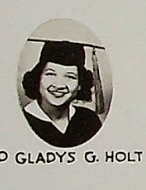
Throughout Gladys Holt Sokolow’s life, her experience at school and education in general played a crucial role, which all began with the importance of education stressed by her parents. Gladys attended both the Calfee Training School in Pulaski, Pulaski County, Virginia, and the Christiansburg Institute in Christiansburg, Montgomery County, Virginia. Gladys Holt fondly remembered Calfee and Christiansburg Institute. A specific teacher who stood out to her at Calfee was Mrs. Cathleen Jenkins Santa Cruz, who taught her in second grade 28. She remembered the commute to CI being at least an hour and a half each way on the bus, which brought up challenges that limited her educational and extracurricular opportunities due to so much time spent during the commute to and from school each day29. Still, she was determined to receive her education and attend CI and therefore made the trip each morning despite its length. Beginning in 1949, Gladys reflected on her time at CII as a positive experience with teachers whom she respected and appreciated, and the school made her realize her love of the subject of math30. As a member of multiple clubs at CI, including the Glee, Science, and Math Club, Gladys enjoyed her time at school and school dances. Graduating in 1953, Gladys Holt received her High School diploma from CI and began a teaching job in Pulaski shortly after 31. Joining the Christiansburg Institute Alumni Association and Christiansburg Institute Board of Directors (BoD) after her retirement, she was heavily involved in both organizations until her passing in 2024. Gladys Holt Sokolow will always be remembered as someone who took pride and ownership of her time at CI. Therefore, her graduation photo from 1953 holds a prominent space on the right side of the quilt design to commemorate all her accomplishments because of CI, and her service back to the local communities with her involvement in the Christiansburg Institute Alumni Association (CIAA) and the Christiansburg Institute Board of Directors.
Photo: Gladys G. Holt taken from 1953 Christiansburg Industrial Institute Yearbook
Mary Della Holt Davis
Born in 1931 as the third of four children to Randall C. Holt and Elsie Ann Holt, Mary D. Holt attended Calfee Training School and Christiansburg Industrial Institute, like her three other siblings. As the only child of the Holt family, who signed onto the Corbin et al. v. County School Board of Pulaski County, VA. et al. lawsuit by her father, Randall C. Holt, Mary D. Holt had her first impression of the importance of education from her father at a very early age. Just like her three siblings, Mary continued her education beyond high school and pursued a career in healthcare as a nurse after graduation32. While living in Chicago, Mary often visited or had family from Pulaski visit, and kept close contact with her family in Virginia. After she and her husband, Al Davis, moved from Chicago to Northern Virginia because of Al Davis’s new position within the Jimmy Carter administration, Mary could visit her family in Pulaski more frequently, creating fond memories between George and Kathleen Morrison and their Aunt Mary33. Described by George as “the most loving, sweetest, kindest person you’d ever meet,” Mary made a lasting impression on her nieces and nephews, as well as the rest of the family at their many social gatherings and reunions she attended.
Cecil E. Holt
Born December 26th, 1928, Cecil was the second-born and only son of Randall and Elsie Ann Holt. In August of 1945, just a month before Japan’s official surrender, Cecil confronted his mother with a choice to either sign off on Cecil’s deployment and know where he would be, or not sign off on the document, resulting in no regular updates or contact with her son34. Elsie Ann chose to know where her son would be, and signed off on his deployment wish to join the US Navy. On the registration card, it is evident that Cecil wrote a false birthday on the card to increase his chances of getting deployed. On top of the card, written in red ink, says “Canceled, Born 12-26-28,” showing the attempted fabrication common among teenage boys during both World Wars who wanted to serve and aid in protecting the United States35. While his eventual deployment to the West Coast of the United States was most likely after the war had ended, Cecil Holt was eager to join the US Navy to serve our country while the conflict was still being fought. Cecil was ready to sacrifice his own livelihood, leave his family, and fight for his country at the age of 16, a time when his siblings and peers of his age were still attending high school. For around 30 years after leaving Pulaski for California, Cecil never returned to Virginia, living out those years in California, meeting his wife, and having children together36. His return 30 years after his departure was remembered by George Morrison, his nephew, as a significant event during his childhood, where the whole family was ecstatic about Cecil driving from California to Pulaski for a visit 37. The day was very emotional for the entire family, with all three of his sisters, Kathleen and George Morrison, and many other extended family members, incredibly excited about Cecil “coming back home”. Cecil himself was also overjoyed to visit his family, with his wife, who came along for the journey, having to continually tell him to stop and take breaks on the long and strenuous trip across the country 38. While he was away from Pulaski for 30 years, his return and reunion with his sisters and extended family show the type of familial connection and bond the Holt family had. While he never lost contact with his family over the many years spent in California because of the regular phone calls and conversations Cecil and his sisters would have, having him come back to Pulaski after leaving at 16 was a monumental event for the Holt family, and one that is remembered fondly. Living out the rest of his life in California with his family, Cecil embodied the values Randall and Elsie Ann Holt instilled in their children, including hard work, sacrifice, and the importance of family.
Sources
- Department of Commerce–Bureau of the Census. Sixteenth Census of the United States. Pulaski, Virginia. Enumerated June 14, 1940. Sheet no. 16A. Entry for Randall C. Holt. Accessed http://www.ancestry.com. and, Commonwealth of Virginia Certificate of Death for Randall Clinton Holt. September 2, 1960. Pulaski, Virginia. Accessed http://www.ancestry.com. ↩︎
- Morrison, Cathleen, and George Morrison. interview by Keiona Henderson. May 10, 2025. Calfee Training School Museum Archive. Accessed May 10, 2025. ↩︎
- Morrison, Irene Holt. “Celebration of Life for Irene Holt Morrison” Jarnigan & Son Mortuary. September 3, 2017. Dublin, Virginia. ↩︎
- Morrison, Irene Holt. “Celebration of Life for Irene Holt Morrison.” ↩︎
- Morrison, Irene Holt. “Celebration of Life for Irene Holt Morrison.” ↩︎
- Morrison, Cathlene, and George Morrison, interview by Keiona Henderson. ↩︎
- Department of Commerce–Bureau of the Census. Seventeenth Census of the United States. Pulaski, Virginia. Enumerated April 24, 1950. Sheet no. 24. Entry for Raynald C. Holt. Accessed http://www.ancestry.com. ↩︎
- Morrison, Irene Holt. “Celebration of Life for Irene Holt Morrison”. ↩︎
- “Dora Furnace, Virginia Iron, Coke & Coal Company.” Hagley Digital Archives. Accessed June 12, 2025. https://digital.hagley.org/1986268_0089. and, Department of Commerce–Bureau of the Census. Thirteenth Census of the United States. Pulaski, Virginia. Enumerated April, 1940. Sheet no. 3B. Entry for Ranall Holt. Accessed on http://www.ancestry.com. ↩︎
- Department of Commerce–Bureau of the Census. Fourteenth Census of the United States. Pulaski, Virginia. Enumerated January and February, 1920. Sheet no. 12A. Entry for R. C. Holt. Accessed http://www.ancestry.com. and, Department of Commerce–Bureau of the Census. Sixteenth Census of the United States. Pulaski, Virginia. Enumerated June 14, 1940. Sheet no. 16A. Entry for Randall C. Holt. Accessed http://www.ancestry.com. ↩︎
- Commonwealth of Virginia Certificate of Death for Randall Clinton Holt. ↩︎
- Department of Commerce–Bureau of the Census. Sixteenth Census of the United States. ↩︎
- “Dora Furnace, Virginia Iron, Coke & Coal Company (Pulaski, Va.).” Hagley Digital Archives. Accessed June 12, 2025. https://digital.hagley.org/1986268_0089. ↩︎
- Morrison, Cathlene, and George Morrison. interview by Keiona Henderson. ↩︎
- Morrison, Cathlene, and George Morrison. interview by Keiona Henderson. ↩︎
- Commonwealth of Virginia Certificate of Death for Randall Clinton Holt. ↩︎
- Morrison, Cathlene, and George Morrison. interview by Keiona Henderson. ↩︎
- Lasseter, Mary Beth. “Savannah’s Black Maestros of Meat.” Southern Foodways Alliance. July 15, 2020. https://www.southernfoodways.org/savannahs-black-maestros-of-meat/. ↩︎
- Commonwealth of Virginia Certificate of Death for Elsie Ann Holt. July 29, 1948. Pulaski, Virginia. Accessed http://www.ancestry.com. ↩︎
- Department of Commerce–Bureau of the Census. Fourteenth Census of the United States. ↩︎
- Department of Commerce–Bureau of the Census. Sixteenth Census of the United States. ↩︎
- Wilson, Midge, and Kathy Russell. “Chapter 7: Relations on the Home Front.” In Divided Sisters: Bridging The Gap Between Black Women and White Women. https://condor.depaul.edu/mwilson/divided/chapter7.html. ↩︎
- Morrison, Irene Holt. “Celebration of Life for Irene Holt Morrison.” ↩︎
- “Oral History with Gladys Sokolow. November 9, 2012. (Ms2019-037).” VT Special Collections and University Archives Online. accessed May 1, 2025. https://digitalsc.lib.vt.edu/items/show/10656. ↩︎
- “Oral History with Gladys Sokolow. November 9, 2012. ↩︎
- “Oral History with Gladys Sokolow. November 9, 2012. ↩︎
- “Oral History with Gladys Sokolow. November 9, 2012. ↩︎
- “Oral History with Gladys Sokolow. November 9, 2012. ↩︎
- “Oral History with Gladys Sokolow. November 9, 2012. ↩︎
- “Oral History with Gladys Sokolow. November 9, 2012. ↩︎
- “Oral History with Gladys Sokolow. November 9, 2012. ↩︎
- Morrison, Cathlene, and George Morrison. interview by Keiona Henderson. ↩︎
- Morrison, Cathlene, and George Morrison. interview by Keiona Henderson. ↩︎
- Morrison, Cathlene, and George Morrison. interview by Keiona Henderson. ↩︎
- National Archives At St. Louis; St. Louis, Missouri. Records of the Selective Service System. World War II: Fourth Registration. “Cecil Edward Holt.”147, 1945. ↩︎
- Morrison, Cathlene, and George Morrison. interview by Keiona Henderson. ↩︎
- Morrison, Cathlene, and George Morrison. interview by Keiona Henderson. ↩︎
- Morrison, Cathlene, and George Morrison. interview by Keiona Henderson. ↩︎
 23/54 PROJECT