Martin
The Martin family lived on a 100-acre farm near Peaks Knob in Draper, Virginia, where James R. Martin Sr. and his wife Lennie Hunter raised ten children among orchards of peaches, pears, and apples. Life on the mountain meant long walks down winding roads to reach school or church, but it also shaped a family rooted in self-reliance, faith, and education. In 1947, Mr. Martin signed his granddaughter Ruth Holt — along with a close family friend, Juanita Taylor — onto the Corbin et al. v. County School Board of Pulaski County (1947) lawsuit, reflecting his belief in better opportunities for the next generation.
Although we do not know what all of the Martin children pursued in adulthood, the accomplishments of those we do know speak to the family’s strong commitment to learning and service. Lucy Martin Harmon earned a master’s degree from Columbia University and became a respected educator; Mary Belle Martin Dickerson earned a doctorate and taught for decades in Chicago; James R. Martin Jr. served in the U.S. Army and later worked for the Veterans Administration; and Charles H. Martin served in World War II before working at the Radford Army Ammunition Plant.
The Martin family’s story reflects a deep connection to land, community, and education — values that carried their children far beyond the mountain they once called home.
Explore the quilt by clicking on the various elements
For best user experience, use full screen mode
An interactive graphic of the quilt square. The linked information can also be found below.
The Martin Family wanted to have a focus on their land and farm in the mountains of Pulaski. Peaks knob was a significant part of the family’s history as that’s where the family land was. The road the family had to travel to get up and down the mountain was added to the quilt design to serve as a physical representation of that road and the metaphorical journey the family had to go on to gain an education to build a better future. Education was a very important factor in the family and the design of the quilt square. Education helped the Martins gain higher economic and social mobility. All of the children finished school at Calfee, and many of them received degrees in higher education.
Learn More About the Martin Family
Martin Family on Lawsuit:
James R. Martin Sr. signed his granddaughter Ruth Holt, and Juanita Taylor, who was most likely a friend of Ruth, onto the Corbin v. Pulaski County School Board lawsuit. Ruth Holt was the daughter of Katie White and Zan Vuren Holt who was born June 14th, 1931.1 She attended both the Calfee Training School and Christiansburg Industrial Institute and eventually moved to Cincinnati Ohio. According to the family, Juanita Taylor was most likely not related to the family, but was signed onto the lawsuit under James R. Martin. She was most likely Ruth’s friend or a family friend who lived near the family up on Peaks Knob. James R. Martin Sr. was the only family out of the 24 families listed on the lawsuit to sign on both a granddaughter and a child who is not directly related to the family. The fact that James R. Martin Sr. not only signed on his grandchild, but he signed on someone who did not even live in the family home or related to the family proves just how much he prioritized education and pushed for change for not only his family, but for others in the community.
Artifacts by Theme
Voting Ballot Box
The Martin family placed great significance on the accessibility to and the act of voting. The family actively participated and took pride in their civic duty. This ballot box also represents the family’s commitment to democratic community organizations such as the NAACP throughout the decades. The Martins were empowered through voting, education, and religion to fight against the inequalities and discrimination towards African Americans.
Graduation Cap
Education played an essential role in the family. During the workshop, Marylen Harmon discussed how education got her family in a better place financially after the end of slavery. All the James R. Martin Sr. children finished high school at Calfee and were encouraged to receive a higher education after high school. At Tuskegee, John got an accounting degree, Lucy got a degree in education, Mary went to Bluefield State, and many other sons joined the military. Lucy became a teacher at Calfee, which shows how important education and schools were to the family and their values.
Bible
The importance of education and religion in the family was often tied together as both institutions made the family feel empowered and capable in their journey to receiving a higher education and making a life for themselves. It was the persistence of education in the children of James R. Martin’s lives, as well as the continually felt presence of God in their lives, that empowered the children to push through adversaries that were in place by white Americans to keep African Americans economically and politically inferior.
Peaks Knob
On the top left of the block design in the purple fabric in the shape of a two peaked mountain with a plateau in the middle represents the mountain in Pulaski known as Peaks Knob. Located at the top of Draper Mountain in Dublin, Virginia, the mountain top has a unique shape to it with its dip in the middle and can be viewed throughout many areas in Pulaski county. According to the family, the Martin family farm was located up near Peaks Knob on Draper Mountain and this location was very significant to the family dynamic and history.
Peaches and Pears
Peaches and Pears were two of the many fruits that were grown on the Martin Family farm up on peaks knob. This section of the quilt block represents the Martin Family Farm with the background consisting of vines and leaves overlaid with the line drawings of the peaches, pears, and Lucy Martin Harmon’s horse named Ted. There were many Black families in Pulaski, Virginia who relied on farming such fruits and other agricultural commodities to provide for their family. Being highly involved in the community, James R. Martin Sr. likely contributed to his community by selling the fruits and other foods grown at the family farm to other Black families in Pulaski. While James R. Martin did work on the railroad and other various jobs throughout his life to support his family, an additional source of income and way of obtaining food while living in a secluded area of the county was highly important for the family.
Tree
On the family’s land on Peaks Knob, there were many different trees on the property with a multitude of memories attached to them. The presence of this tree on the quilt square represents the many different trees and the general rural environment in which the family lived. Marylen Harmon states that she remembers stories of apple trees on the property where the family grew and ate apples. Rural life and self-reliance were the Martin family’s way of life, which is represented by the presence of the large apple tree. James R. Martin Sr.’s descendants today believe that the values of rural farm life were what kept the family close and dedicated to hard work.
Artifacts by Family Member
James R. Martin Sr.
spacer
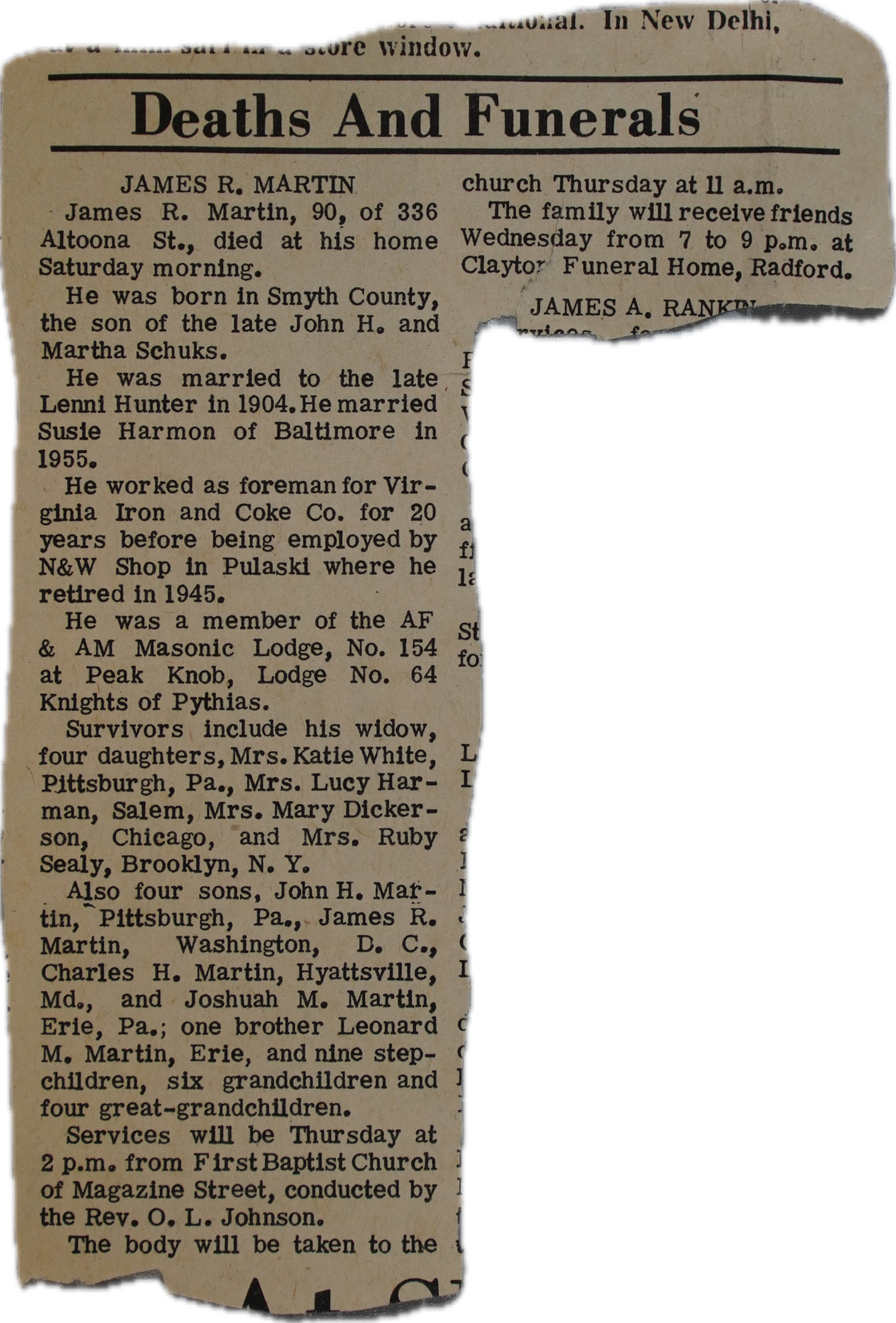
James R. Martin Sr. Obituary
Born October 4th, 1878, James Robert Martin Sr. was a well known member of the Pulaski community. Marrying Lennie Hunter in 1905, James R. Martin and Lennie would have 10 children together.2 He was known and remebered as a hard working man who lived off his 100-acre farm near Peaks Knob in Pulaski. He worked for Virginia Iron Coke and Coal company for over 20 years before working for the Virginia Norfolk and Western Railroad. James R. Martin Sr. was heavily involved in his childrens lives, and the community as he substituted at the Calfee Training School occasionally, a member of the AF and AM Masonic Lodge on Peaks Knob, and regularly attended the First Baptist Church on Magazine Street. Passing away at the age of 90 in 1969, James R. Martin Sr. left long lasting lessons, values, and family traditions onto his children by prioritizing his family, their education, faith, and community involvement. 3
spacer
Road/Railroad
The strip of light purple and silver fabric cutting through the bottom right half of the quilt square is a representation of the road that cut through the mountains of rural Pulaski where the family lived, the metaphorical journey each family member had to endure to receive an education and become successful, as well as the railroad at the bottom of the hill that James R. Martin Sr. worked on. The family traveled daily on winding country roads to go to school, work, and social or religious events, with the country road becoming a major part of the family’s identity and history. The road represents the physical image of the winding country roads the family traveled, as well as the metaphorical road each family member had to experience to achieve their educational goals and aspirations. The many family members’ names along the strip of fabric act as the railroad crossties and the motivation for all the hard work each family member endured, symbolizing the importance of familial connection and support for one another’s work-related, military, and academic achievements. The names that decorate the road include Lucy Martin Harmon, James R. Martin Jr., Charles H. Martin, David Martin, Katie White, Ruby Sealy B. Mary Belle Martin Dickerson, and Joshua Martin. Digitally added are John Henry Martin and Virginia Martin Lucas as these names were uncovered as children of James R. Martin Sr. after the completion of the physical quilt.
Each of the names form a railroad like image with each name being a railroad tie, holding the family together and in place. The presence of a railroad on this same strip of fabric gives the section of the quilt block a third meaning which highlights James R. Martin Sr.’s dedication to taking care of his family by doing difficult labor such as working for the railroad. James R. Martin Sr. would go on to become the manager of the Virginia Iron Coke and Coal company, showing his and his familial commitment to leadership, achievement, and serving the community. Each child of James R. Martin Sr. would learn and take after him after watching his hard work, commitment, and sense of community throughout their childhood
Lucy Eva Martin Harmon
Lucy Martin Harmon was born in 1914 to parents James R. Martin Sr. and Lennie H. Martin.4 According to her obituary, she attended Tuskegee Institute, where one of her teachers was George Washington Carver. She graduated with a degree in elementary education from Bluefield State College in Bluefield, West Virginia, where she subsequently earned a Master of Arts in Curriculum and Teaching from Columbia University.5 She joined the faculty of the Calfee School for the 1937-1938 academic year, teaching second and third grades. After the school burned late in 1938, she and many faculty colleagues lobbied the Pulaski County School Board to build a new facility. Lucy Martin Harmon was an instrumental member of the Pulaski and Calfee community as her continuous drive to fight for equal educational opportunities for the Black children of Pulaski led to the Corbin et al. v. County School Board of Pulaski County, VA. et al. case being filed. On top of her commitment towards equalization of education, Lucy Martin Harmon is remembered as a loving mother and a woman who had many “mountain stories” by her two children Marelyn Harmon and Chauncey C. Harmon Jr.
Ted the Horse
In the bottom left corner of the quilt block in the section that represents the family’s farm, there is a line drawing of a horse resembling Lucy Martin Harmon’s horse, named Ted. Lucy loved this horse and had a strong emotional attachment to Ted. The horse tragically died from exhaustion after a group of young white boys stole and rode the horse until it couldn’t continue any further. The Martin family wanted to represent Ted in the quilt square to show Lucy’s love and compassion for him and the struggles Black Americans faced due to racism in the United States in the 20th century.
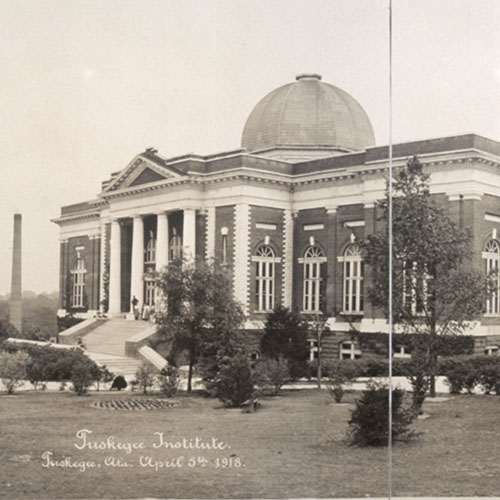
Tuskegee Building
Both John and Lucy Martin attended the highly acclaimed Tuskegee Institute in Alabama. The Tuskeegee Institute, now Tuskeegee University, was founded in 1881 by Booker T. Washington as the Tuskegee Normal School for Colored Teachers with a mission to empower African Americans through self-reliance and economic independence.6 The school quickly began to adopt a curriculum that focused on industrial and vocational education that was a common practice among Black colleges and universities in the United States. The institute remains very important to the family because of Lucy and John’s connections to the college, which allowed them to receive a higher education and have successful and fulfilling careers. Lucy studied education at Tuskegee Institute, a prevalent yet significant degree that Black women, and women in general, were highly encouraged to pursue. It was considered an acceptable “feminine” career path for women then.
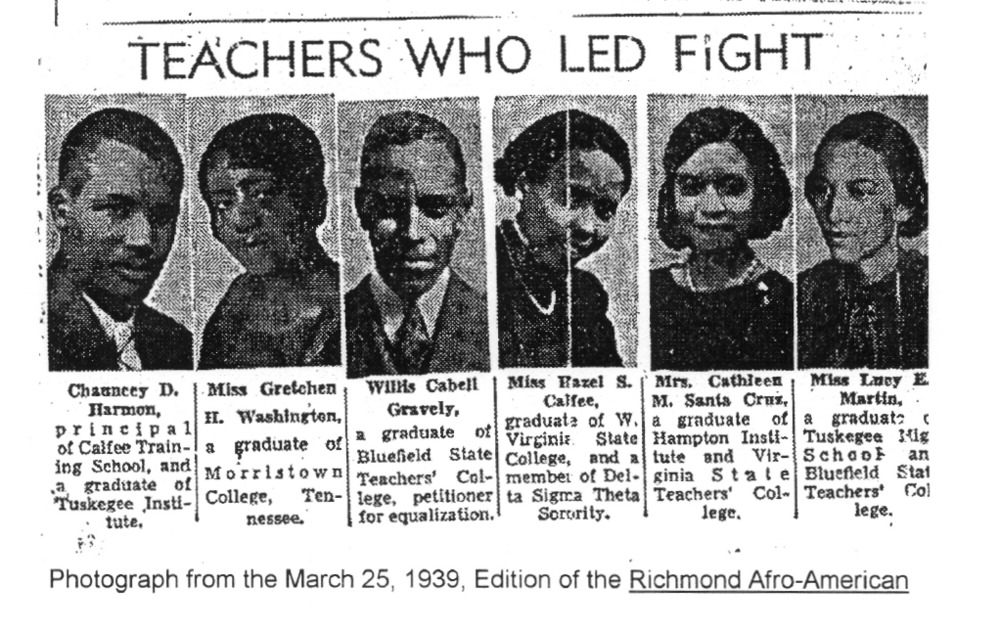
“Teachers Who Led Fight” Article
Lucy E. Martin is featured in the March 25th, 1939 edition of The Afro American newspaper, where she, along with Chaucney D. Harmon, Miss Gretchen H. Washington, Willis Cabell Gravely, Miss Hazel S. Calfee, and Mrs. Cathleen Jenkins Santa Cruz confrunted the Pulaski County School Board to demand a well-equipped elementary school, free bus transportation, and tuition for high school aged Black children. The Pulaski County School Board “quickly granted the delegation its requests.” 7Black educators who marched on the Pulaski County School Board in March of 1939 were accompanied by J. Hewin, Jr., Richmond Attorney and Counsel for the NAACP. This march by Black educators on the Pulaski School Board, “under the banner of the NAACP, was their last resort because no responses were made to communications asking for a date to discuss inequalities in the school system of Pulaski.”8 This march led by Black teachers, including Lucy E. Martin, on the Pulaski School Board, would foreshadow and set a precedent for the actions to address inequalities in the Pulaski School system by Black parents and educators in the Corbin et al. v. County School Board of Pulaski County, VA. et al. case in the late 1940s.
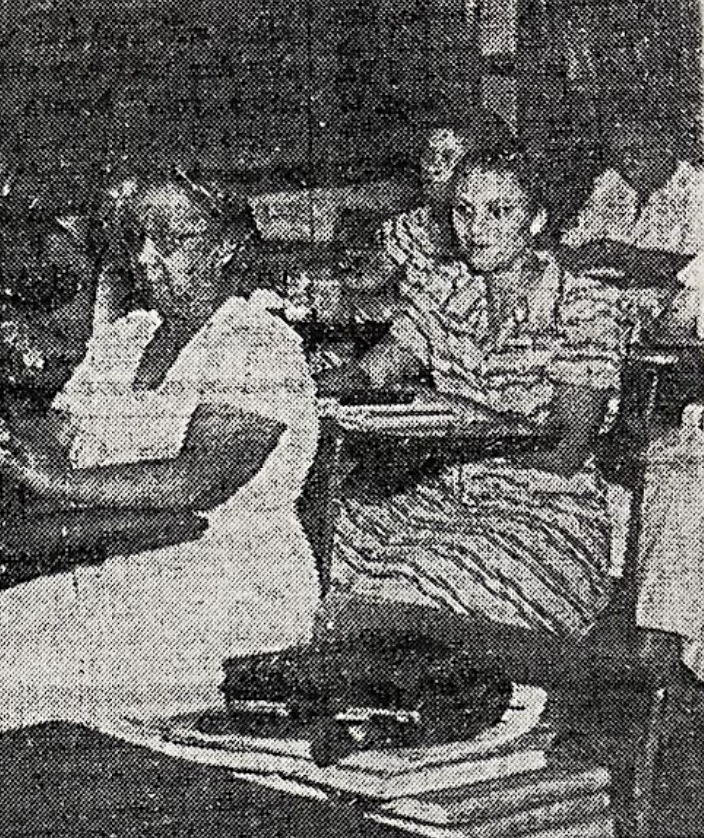
Lucy Martin Harmon Newspaper Image
This particular image of Lucy Martin Harmon depicts her partaking in a teacher professional development meeting at Calfee, as reported by The Southwest Times on September 2nd, 1951.9 This particular photograph about the teacher’s workshop was entitled “Negro Teachers’ Workshop.” The Southwest Times segregated its news of the community, as anything news related to the African American community or any non-white community was restricted to the “Colored News” section towards the back of the local newspaper for several decades during segregation in Virginia. This teacher’s workshop included educators from Calfee Training School, William Gresham School, and Christiansburg Institute. The Southwest Times, a white operated and segregated local newspaper, portrays the teacher’s workshop in a negative tone, claiming that the Black teachers were “discussing school problems at Calfee School.” Not acknowledging that segregation was severely underfunding Black schools and underpaying Black teachers, in comparison to the white schools in Pulaski County, throughout Virginia, and the Southern United States. As historical evidence and personal accounts about Black educators in Pulaski County, Virginia have constantly shown, these Black educators were Civil Rights activists devoted to addressing the systemic racial discrimination and segregation against their children and themselves. The September 1951 Teacher’s Workshop in Pulaski is another example of the African American community, specifically educators, coming together to address the inequitable conditions of segregated schools in Virginia and discussing ways to improve the lives and education of their students, and the Black children of Pulaski County that were not permitted by Virginia law to attend any of the white schools which received greater funds and resources as well as higher wages for educators.
Spacer
George Washington Carver
George Washington Carver was once a professor at Tuskegee Institute and program director of agricultural research. Both Lucy Martin Harmon and John Henry Martin attended Tuskegee during Carver’s years at the school. While working in the dining hall, Lucy even served Dr. Carver his meals. As the Lucy Martin Harmon Digitized interview stated, Dr. Carver inspired Lucy to become a teacher.10 George Washington Carver was and continues to be an inspiration for the Martin family as a symbol for the importance of hard work and education.
“When I tell you to do something, don’t ask why.”
Lucy Martin Harmon used this quote with her two children Marylen and Chauncy Harmon Jr. when they were in immediate danger and she did not have time to explain why they needed to listen to her. Lucy got this quote from her mother because of an instance where Lucy and her siblings were picking blackberries in Draper. The siblings were on top of a rock collecting berries when her mother Lennie yelled, “ride the sapling!” trying to make her children come away from the rock onto the other side of the bank. Underneath the rock held a den of copperheads that were slowly coiling up and preparing to bite the children. Lucy’s mother, and later Lucy herself, used this quote and this story to ensure the safety of their children when they were in immediate danger.
James R. Martin Jr.
James R. Martin Jr. was born July 8, 1918 in Pulaski, to parents James R. Martin Sr. and Lennie Hunter Martin.11 After attending the Calfee school in Pulaski, he went on to attend MorrisTown College and Bluefield State College to receive a B.S. Degree in Chemistry.12 He was a member of the Alpha Phi Alpha Fraternity during his college years, along with being a member of the Bluefield College Alumni Association post-graduation. After college, James R. Martin Jr served in World War II in the U.S. Army. Moving to Washington D.C., he was employed by the Veterans Administration serving as Personnel Manager at the Headstone Branch Memorial Division in Washington D.C. After retirement, he moved to Salem and lived with his sister, Lucy M. Harmon for three years until his death in 1991.13
Charles H. Martin
Born in 1920, Charles H Martin was born in 1920 and attended both the Calfee school and Christiansburg Industrial Institute. Attending Howard University in Washington D.C. after high school, he moved to Hyattsville Maryland after graduation and married Helen Martin.14 Charles Martin was also a World War II veteran similarly to his brother James R. Martin Jr and was employed at the Radford Army Ammunition Plant at the time of his enlistment in 1941.
David Martin
Born in 1926, David Martin died less than a month after his birth in Pulaski, Virginia. He was the son of James R. Martin Sr. and Lennie Martin who the family wanted to honor and celebrate. Despite his premature passing, David Martin was well loved and remembered and was included in the list of James R. Martin Sr. and Lennie Martin’s children by the Martin Family.
Katie White
Katie White was the first born child of James R. Martin Sr. and Lennie Martin born on September 17th 1912. She married Zan Vuren Holt, brother of Randall C. Holt from the Holt family that was included in the lawsuit, and had Ruth Holt in June of 1931. Ruth Holt would continue to live with James R. Martin Sr., her grandfather who signed her onto the Corbin et al. v. County School Board of Pulaski County, VA. et al. court case in 1947. Katie would remarry in 1947 to Willard G. White and moved to Pittsburg, Pennsylvania.
Ruby Sealy
Ruby Martin Sealy was born in 1923 to parents James R. Martin Sr. and Lennie Martin. According to her family members obituaries, Ruby had moved to Brooklyn N.Y. sometime before the death of her father in 1969. She had stayed in Brooklyn N.Y. until her death in 2005.
Mary Belle Martin Dickerson
Dr. Mary Belle Martin Dickerson was the daughter of James R. Martin Sr. and Lennie Hunter Martin who was most likely born in 1917. She was a highly educated individual who, according to her obituary, attended Morristown College and Bluefield State College for Undergraduate degrees, obtained post graduate degrees from Northwestern University, Governor State, and Chicago State University, and earned her Doctoral degree from Walden University. She remained in Chicago, Illinois until her passing in 2002.15 Serving as a Chicago-area elementary school teacher for 40 years, the lesson to prioritize education was certainly passed down to Dr. Mary Dickerson. Starting out at Calfee and Christiansburg Institute, what Mary Martin Dickerson was able to accomplish academically is highly impressive and difficult. Her education she received at the start of her academic journey in Pulaski and Christiansburg enabled her to further her education in such an academically challenging yet rewarding way. Becoming a Chicago elementary school teacher despite her many degrees and accomplishments goes to show how Dr. Mary Martin Dickerson prioritized education not only for herself, but for her community. The lessons instilled by her parents that focused on the importance of education motivated Mary, along with her siblings to go on and achieve such outstanding accomplishments.
Joshua Martin
Born around 1921, Joshua Martin was the son of James R. Martin Sr. and Lennie Hunter Martin. He attended both Calfee Training School and Christiansburg Industrial Institute for his elementary and secondary education. After graduating high school from CII, Joshua Martin attended Virginia State, now Virginia State University in Petersburg, Virginia.16 According to his siblings obituaries, Joshua Martin had moved to Erie Pennsylvania in the later years of his life.
Virginia Martin Lucas
Virginia Martin Lucas was the daughter of James R. Martin and Lennie Martin. Not much is known about Virginia as she moved from Pulaski to Brooklyn NY and died at the young age of 35. Her obituary from the Southwest Times describes her as a former teacher of Christiansburg Institute assumingly before her move to Brooklyn.17 While her name is not present on the physical quilt, her name was digitally added next to her siblings due to an increase in family information and history.
John Henry Martin
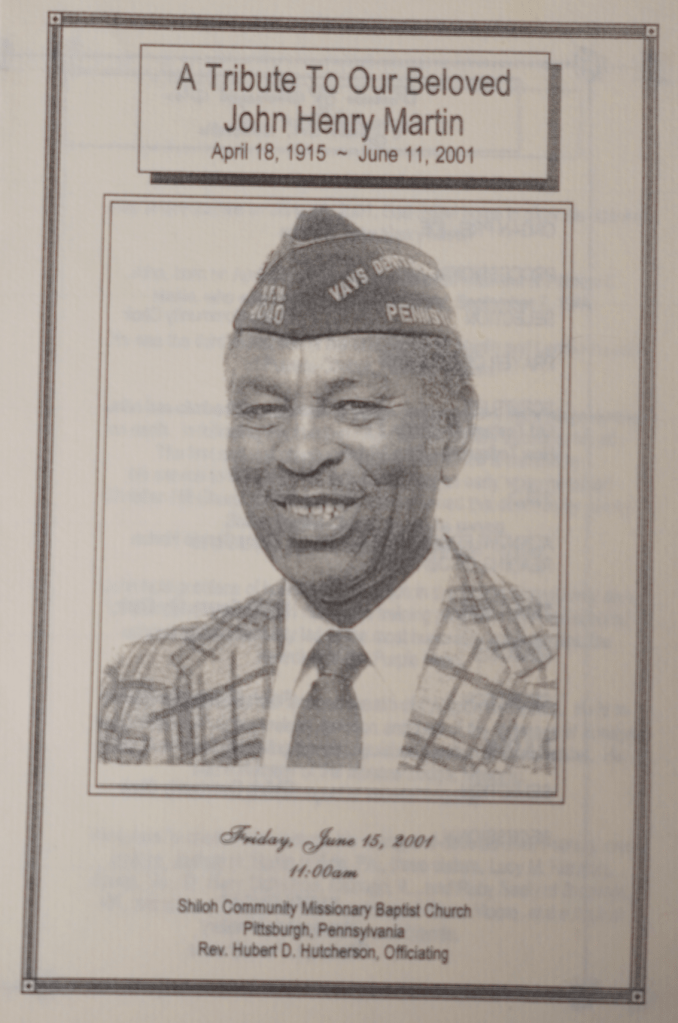
John Henry Martin was born on April 18th, 1915 as the third eldest son of James R. Martin Sr. and Lennie Hunter Martin. He attended both Calfee and Christiansburg Industrial Institute along with his siblings, and attended Tuskegee Institute with his sister Lucy. He was very involved in the Baptist Church in his younger days, and into his elder years. According to his obituary, John Henry Martin held multiple positions of honor within the United States Army as a Lieutenant Colonel, including the Purple Heart. Beginning his academic career both at Calfee and CII, John Henry Martin was able to lead a successful and fruitful life both academically and militarily challenging yet rewarding. The Martin family values of prioritizing education and hard work attributed to the life John Henry Martin was able to lead and the success he witnessed despite economic and educational barriers placed on African Americans in the 20th century.
Sources
- Virginia Department of Health; Richmond, VA, USA. Virginia, Births, 1912-1923. Lehi, UT, USA. Accessed through Ancestry.com, August 20, 2025. ↩︎
- Virginia, Marriages, 1785-1940. Salt Lake City, Utah. FamilySearch, 2013. Accessed Ancestry.com, August 20, 2025. ↩︎
- “James Robert Martin Sr. (1878-1969).” Find a Grave. Accessed August 19, 2025. https://www.findagrave.com/memorial/37274419/james-robert-martin. ↩︎
- “Lucy Martin Harmon (1914-2013).” Find a Grave. Accessed August 19, 2025. https://www.findagrave.com/memorial/110410376/lucy-harmon. ↩︎
- “Lucy Martin Harmon (1914-2013).” Find a Grave. Accessed August 19, 2025. https://www.findagrave.com/memorial/110410376/lucy-harmon. ↩︎
- “History of Tuskegee University.” Tuskegee University. Accessed August 19, 2025. https://www.tuskegee.edu/about-us/history-and-mission. ↩︎
- J. Robert Smith. “Pulaski Scores in Fight for Schools,” Calfee Training School Museum Digital Archive, accessed August 20, 2025, https://calfee.omeka.net/items/show/453. ↩︎
- J. Robert Smith. “Pulaski Scores in Fight for Schools.” ↩︎
- “Colored News, Negro Teachers Workshop.” The Southwest Times. September 2, 1951. Accessed on Virginia Chronicle Library of Virginia Digital Newspaper Archive. https://www.virginiachronicle.com/. ↩︎
- Harmon, Lucy Martin. “Interview with Lucy Martin Harmon.” April 29, 2008. Calfee Center Archives: Lucy Martin Harmon Digital Collection. ↩︎
- “Obituary Martin, J.” Virginia Tech Scholarly Communication University Libraries. March 16, 1991. https://scholar.lib.vt.edu/VA-news/ROA-Times/issues/1991/rt9103/910316/03160045.htm. ↩︎
- “Obituary Martin, J.” Virginia Tech Scholarly Communication University Libraries. ↩︎
- “Obituary Martin, J.” Virginia Tech Scholarly Communication University Libraries. ↩︎
- “Deaths and Funerals, Charles H. Martin.” The Southwest Times. June 7,1971. Page 2. Accessed on Virginia Chronicle Library of Virginia Digital Newspaper Archive. https://www.virginiachronicle.com/. ↩︎
- “Obituaries, Mary Belle Martin Dickenson.” The Roanoke Times. June 27, 2002. Page 29. Accessed on Newspapers.com by Ancestry. https://www.newspapers.com/image/921068369/. ↩︎
- “Conveyances.” The Southwest Times. October 30th, 1942. Page 6. Accessed on Virginia Chronicle Library of Virginia Digital Newspaper Archive. https://www.virginiachronicle.com/. ↩︎
- “Colored Deaths, Mrs. Virginia M. Lucas.” The Southwest Times. March 21, 1960. Page 3. Accessed on Virginia Chronicle Library of Virginia Digital Newspaper Archive. https://www.virginiachronicle.com/. ↩︎
 23/54 PROJECT