
Murphy
Anna G. Murphy married John Lee Murphy Sr., and together they raised five children in Pulaski County. In 1947, Anna signed her son, Hilton Dallas Murphy, onto the Corbin et al. v. County School Board of Pulaski County (1947) lawsuit, joining 22 other Black families in the fight for equal education. John worked as a barber at the Harmon & Murphy Barber Shop in the late 1920s and early 1930s, while Anna worked as a private domestic worker — both occupations reflecting the skill, discipline, and determination they modeled for their children.
Although we do not know what all of the Murphy children pursued, Hilton’s path stands out: he graduated from Calfee Training School, served in the U.S. Army during the Korean War, and later made aviation history as the first African-American military pilot to fly MACH II in the F-106 “Delta Dart,” one of the Air Force’s most advanced aircraft of its era. The Murphy family legacy is one of hard work, resilience, and groundbreaking achievement that carried their Pulaski roots far beyond the county line.
Explore the quilt by clicking on the various elements
For best user experience, use full screen mode
An interactive graphic of the quilt square. The linked information can also be found below.
The fabric was arranged on the quilt square to represent a runway, clouds, and a plane. The runway is representative of Hilton Murphy’s career as an accomplished pilot. The runway is also meant to symbolize the ascension of the family starting with the mother, Anna Murphy, who was a domestic worker and the great things the children were able to do as a result of her dedication. Hilton was a pilot, so the plane, made from accent fabric, is flying within the clouds made from the other fabrics.
Learn More About the Murphy Family
Artifacts by Family Member
Anna George Murphy
Murphy Names Signed onto Lawsuit
Anna G. Murphy signed on her son, Hilton Dallas Murphy, onto the 1947 Corbin et al. v. County School Board of Pulaski County court case to join the 22 other Black families of Pulaksi to fight for education equality amongst the schools for their children.
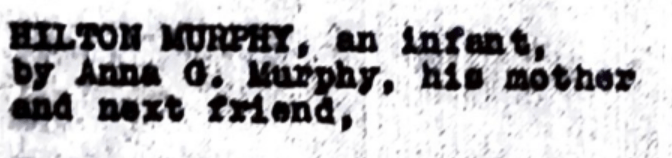
“Hilton Murphy, an infant, by Anna G. Murphy, his mother and next friend,”
Line drawings on the runway
Anna George Murphy was born on June 6, 1891, in Little Valley Ridge, Tazewell, Virginia, to parents George and Mary George.1 In 1915, Anna married John Lee Murphy Sr. of Pulaski, Virginia.2 The couple had five children: Aileen Murphy Smith, Mary Murphy Russell, John Lee Murphy Jr., James Murphy, and Hilton Murphy.3 Both Anna and John worked diligently within the community to support their children. John worked as a barber for Harmon & Murphy Barber Shop in the late 1920s and early 1930s.4 Anna worked as a private domestic worker, a common occupation for Black women across history.5
After the Civil War, large numbers of Black women found jobs as domestic workers. Their work was divided into three roles: cooking, washing, and housekeeping. These women often faced abuse in the workplace. Similar to enslaved women, these women resisted in more ways than one, such as boycotting, quitting, fleeing, theft, and confiding in each other about unfavorable employers. However, this resistance was not without its backlash from white employers who would pursue legal action. According to the National Domestic Workers Alliance, “Black women workers were at the forefront of the labor movement after the Civil War,” fighting for increased “autonomy” in their occupations. These women activated their own labor unions and alliances to advocate for better working conditions, fair contracts, and better hours. The push for better working conditions persisted for generations from the end of the Civil War to the present day.6
Anna endured the grueling demands of domestic work, and her sacrifice and hard work paved the way for her children to achieve greatness.
Hilton Dallas Murphy

Photo of Hilton Dallas Murphy
Hilton Dallas Murphy was born on September 16, 1930, to parents Anna and John Lee Murphy Sr, the youngest of five children. After schooling at Calfee Training School, Christiansburg Institute, Virginia State College, and Howard University, Hilton entered the Air Force. In 1956, Hilton married Bettye White Murphy in Texas, and the couple had four children: Wanda Murphy, Derek Murphy, Kelly Corhen, and Lee H Murphy. This photo depicts Hilton in the USAF, date unknown.7
Calfee Center Logo
Hilton Murphy attended Calfee Training School, where he demonstrated a dedication to his academics and school community. While attending Calfee, Hilton maintained excellent grades. The Southwest Times reported on his exemplary achievement, maintaining “good scholastic average, good attendance records, and good morals and healthy habits,” which is required for the honor roll.8 He achieved this honor several times throughout his career at Calfee.9 Additionally, Hilton was involved in extracurriculars including the “Our Gang” club and the 1944 school play “Little Clodhopper.”10 Hilton departed Calfee in 1944, leaving a lasting legacy as class president and an enthusiastic student.11
Trojan Line Drawing
Before his time in the military, Hilton Murphy attended Virginia State College, now known as Virginia State University.12 On March 6, 1882, the university was founded as “Virginia Normal and Collegiate Institute.” It opened in 1883 for 126 students and seven faculty members. John Mercer Langston, a Virginia Congressman, served as the school’s first president. In 1930, the school was renamed to “Virginia State College for Negros,” then “Virginia State College” in 1946, and finally “Virginia State University” in 1976.13 In 1936, the University designated a Trojan as its mascot, which is depicted on the quilt to symbolize Hilton’s time at VSU.14
Bison Line Drawing
In addition to Virginia State University, Hilton Murphy also attended Howard University.15 Howard University opened in 1867, two years after the end of the American Civil War.16 Howard’s mascot is the Bison, which first appeared in a 1923 yearbook, partly originating from the affectionate label ascribed by Native Americans to colored soldiers during the Civil War.17
Tiger Line Drawing
After attending Calfee Training School, Hilton Murphy continued his education at Christiansburg Industrial Institute in Montgomery County, Virginia.18 Christiansburg Institute was the only school available for Black high school students from Pulaski to attend at the time, partially due to the 1947 Corbin et al. v. County School Board of Pulaski County, in which Hilton was cited alongside his mother Anna. On November 15, 1946, Hilton and four other Pulaski natives, Mahatma Corbin, John McMickle, Andrew Holland, and Fred Bland, faced Covington High School in a “football contest” at Calfee Park. According to the Southwest Times, this contest brought together “two of the best colored elevens” in the area.19 The mascot of Christiansburg Institute was the golden tigers, which is stitched on the quilt to represent Hilton’s stint at the school.
United States Air Force Logo
In November 1952, Hilton Murphy began aviation training in Waco, Texas. The following year, Hilton completed his jet pilot training in Delaware. In the United States Air Force, Hilton served his country as an accomplished jet fighter pilot.20
During World War II, the Tuskegee Airmen became the first African American Army Air Forces pilots. These men broke racial barriers in the military as the AAF made special orders, despite policies of segregation, to advance their training in all-white training programs. In opposition to racist assumptions, the Tuskegee Airmen demonstrated the skill, courage, and determination needed to serve in the armed forces. They played a crucial role in laying the groundwork for the eventual desegregation of the military. In 2007, Congress awarded the Tuskegee Airmen a Congressional Gold Medal for their military service21. According to the Air Force Personnel Center, as of December 2024, only 16% of the Air Force is Black,22 and an even smaller percentage of pilots are Black.23 In 2025, the Trump Administration removed statistics and history about Black pilots in the Air Force as part of their anti-DEI policies. This type of erasure of African American pilots in the Air Force emphasizes the importance of the 23/54 Project’s work.
Towards the end of his career, Hilton became an Air Traffic Control Specialist for the Federal Aviation Administration (FAA). Hilton proved well distinguished in several areas with his commitment to education and service.
“1.534.54 MPH”
According to his obituary, Hilton was “the first African-American military pilot to fly MACH II (twice the speed of sound) in the F106, Phase III, at Edwards AFB commanded by Col. Chuck Yeager.”24 The F106 “Delta Dart” took its first flight in 1956 and was retired to the Air Force Museum in 1986.25 This number, 1.534.54, symbolizes the miles per hour considered Mach II speed. Hilton’s remarkable contribution to Air Force history is widely represented on the quilt.
Sources
- Library of Virginia; Richmond, Va, USA. Virginia, Birth Registers, 1853-1911, Lehi, UT, USA. Accessed through Ancestry.com. September 7, 2025. ↩︎
- Library of Virginia; Richmond, VA. Virginia Marriages, 1853-1935. Lehi, UT, USA. Accessed through Ancestry.com. September 7, 2025. ↩︎
- “Deaths, Mrs. Anna G. Murphy.” The Southwest Times. March 19, 1963. Page 5. Accessed on Virginia Chronicle Library of Virginia Digital Newspaper Archive. https://www.virginiachronicle.com/. ↩︎
- “MOVED! The Harman & Murphy Barber Shop.” The Southwest Times. February 2, 1923. Page 8. Accessed on Virginia Chronicle Library of Virginia Digital Newspaper Archive. https://www.virginiachronicle.com/. ↩︎
- 1940 United States Federal Census. Provo, UT, USA. Accessed through Ancestry.com. September 7, 2025. ↩︎
- “A History of Domestic Work and Worker Organizing.” National Domestic Workers Alliance. Accessed September 7, 2025. https://www.dwherstories.com/. ↩︎
- “Hilton Murphy Obituary (2004).” The Dallas Morning News. April 28, 2004. https://obits.dallasnews.com/us/obituaries/dallasmorningnews/name/hilton-murphy-obituary?id=39665981&_gl=1%2A9yczag%2A_gcl_au%2AMTE2NTg1OTY4MS4xNzQzNTU0ODc1. ↩︎
- “Colored News.” The Southwest Times. December 3, 1939. Page 7. Accessed on Virginia Chronicle Library of Virginia Digital Newspaper Archive. https://www.virginiachronicle.com/. ↩︎
- “Colored News.” The Southwest Times. October 17, 1941. Page 2. Accessed on Virginia Chronicle Library of Virginia Digital Newspaper Archive. https://www.virginiachronicle.com/. ↩︎
- “Colored News.” The Southwest Times. April 26, 1944. Page 6. Accessed on Virginia Chronicle Library of Virginia Digital Newspaper Archive. https://www.virginiachronicle.com/. ↩︎
- “Outgoing Calfee Training Class of 1944” The Southwest Times. June 2, 1944. Page 2. Accessed on Virginia Chronicle Library of Virginia Digital Newspaper Archive. https://www.virginiachronicle.com/. ↩︎
- “Hilton Murphy Obituary (2004).” The Dallas Morning News. April 28, 2004. https://obits.dallasnews.com/us/obituaries/dallasmorningnews/name/hilton-murphy-obituary?id=39665981&_gl=1%2A9yczag%2A_gcl_au%2AMTE2NTg1OTY4MS4xNzQzNTU0ODc1. ↩︎
- “History of VSU.” Virginia State University, September 5, 2025. https://www.vsu.edu/about/history/. ↩︎
- “History of the Logo.” Virginia State University Alumni Association. Accessed September 7, 2025. https://www.vsuaaonline.com/about-us/history-of-the-logo#:~:text=During%20the%20early%20years%20of,as%20its%20official%20school%20mascot. ↩︎
- “Hilton Murphy Obituary (2004).” The Dallas Morning News. April 28, 2004. https://obits.dallasnews.com/us/obituaries/dallasmorningnews/name/hilton-murphy-obituary?id=39665981&_gl=1%2A9yczag%2A_gcl_au%2AMTE2NTg1OTY4MS4xNzQzNTU0ODc1. ↩︎
- “History: About Howard.” Howard University. Accessed September 7, 2025. https://howard.edu/about/history. ↩︎
- Hill, Edward. “Birth of the Bison.” The Dig at Howard University. October 7, 2022. https://thedig.howard.edu/all-stories/birth-bison. ↩︎
- “Hilton Murphy Obituary (2004).” The Dallas Morning News. April 28, 2004. https://obits.dallasnews.com/us/obituaries/dallasmorningnews/name/hilton-murphy-obituary?id=39665981&_gl=1%2A9yczag%2A_gcl_au%2AMTE2NTg1OTY4MS4xNzQzNTU0ODc1. ↩︎
- “Negro Elevens to Play Here Friday Evening.” The Southwest Times. November 13, 1946. Page 5. Accessed on Virginia Chronicle Library of Virginia Digital Newspaper Archive. https://www.virginiachronicle.com/. ↩︎
- “Completes Training” The Southwest Times. October 4, 1953. Page 6. Accessed on Virginia Chronicle Library of Virginia Digital Newspaper Archive. https://www.virginiachronicle.com/.(SWT 10/04/1953) ↩︎
- “Tuskegee Airmen.” National Museum of African American History and Culture. Accessed September 7, 2025. https://nmaahc.si.edu/explore/stories/tuskegee-airmen. ↩︎
- “Military Demographics.” Air Force Personal Center. Accessed December 31, 2024. https://www.afpc.af.mil/Portals/70/documents/DEMOGRAPHICS/MilDemographics%20Q1%202025.pdf?ver=6StXpPGNM-jrM6tv6fJK6A%3D%3D. ↩︎
- Cohen, Rachel. “Here’s the Air Force’s Plan to Diversify Its Pilot Corps.” Air Force Times. March 19, 2021. https://www.airforcetimes.com/news/your-air-force/2021/03/19/heres-the-air-forces-plan-to-diversify-its-pilot-corps/. ↩︎
- “Hilton Murphy Obituary (2004).” The Dallas Morning News. April 28, 2004. https://obits.dallasnews.com/us/obituaries/dallasmorningnews/name/hilton-murphy-obituary?id=39665981&_gl=1%2A9yczag%2A_gcl_au%2AMTE2NTg1OTY4MS4xNzQzNTU0ODc1. ↩︎
- “Convair F-106A Delta Dart.” National Museum of the United States Air Force. Accessed September 7, 2025. https://www.nationalmuseum.af.mil/Visit/Museum-Exhibits/Fact-Sheets/Display/Article/196408/convair-f-106a-delta-dart/. ↩︎
 23/54 PROJECT